

Bungalow or Care Home? Understanding the Lavender Fields Care Village
If you're researching care options for yourself or a family member, you've probably noticed that "care village" doesn't mean the same thing from one provider to the next. Some are marketing language for a single building with a nice name. Others are genuinely two different living arrangements loosely based on the same site.
At Lavender Fields, it means something more specific than either of those. Independent bungalow living and full residential care at Provence House exist side by side, on the same site, designed to work together as one continuous model rather than two separate products you choose between once and never revisit.
This article sets out exactly how that model works, who each option suits, what changes if care needs increase, and how to make the decision with confidence rather than guesswork.
What's the actual difference between a village bungalow and Provence House?
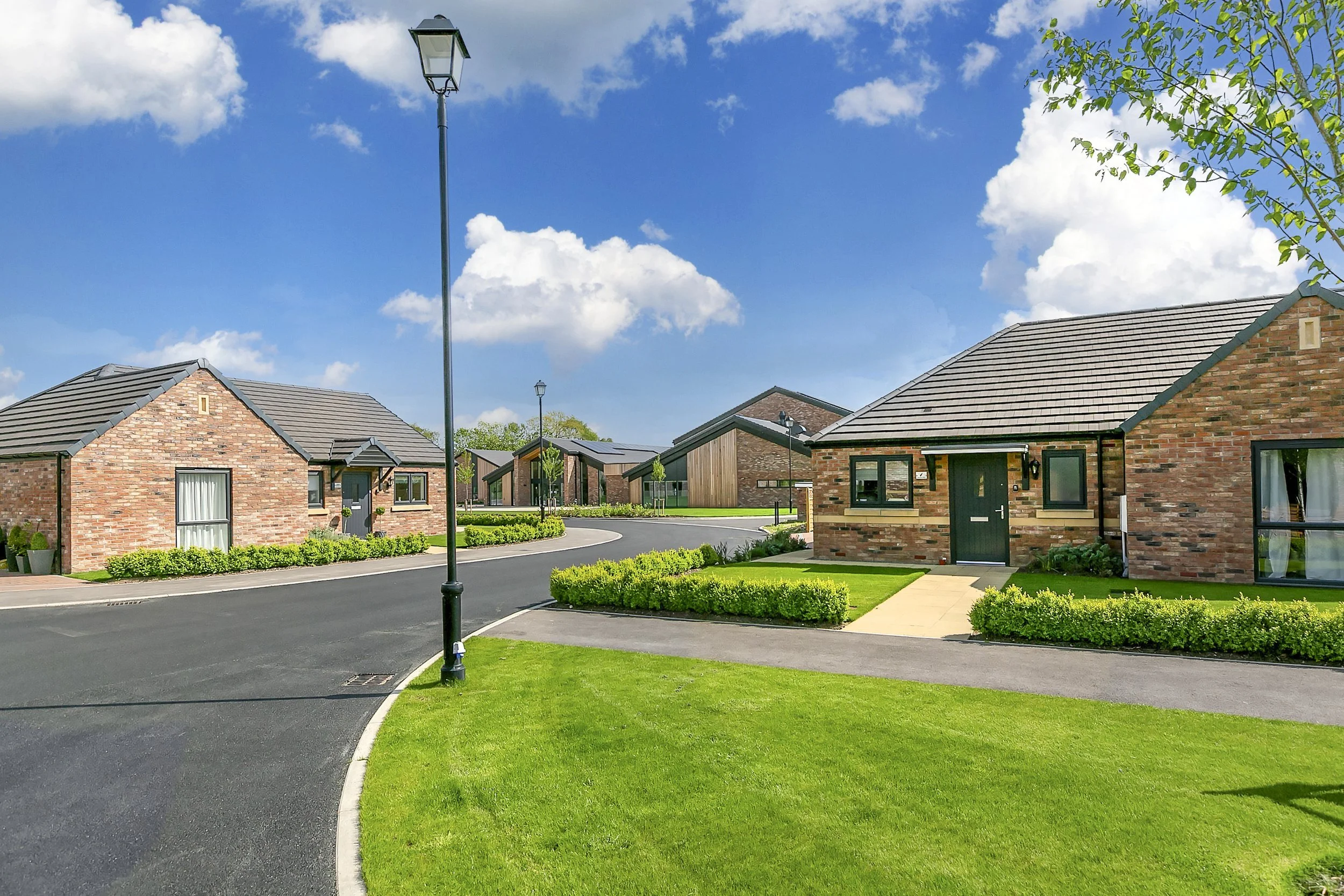
A bungalow is your own home. You have your own front door, your own patio and garden, and full independence, with the reassurance of a supportive community and care nearby if and when you need it. Take a look at our bungalows for a fuller picture of what that looks like day to day.
Provence House is our specialist care home, offering full-time residential care with round-the-clock support built in as standard, not as an add-on. For those living with dementia specifically, our dementia care page covers what that support involves.
The simplest way to think about the difference: bungalows suit people who are largely managing well but want the security of care close by. Provence House suits those who need consistent daily support with personal care, mobility, medication, or the safety concerns that often come with more advanced dementia.
Neither option is a compromise. They're two different stages of the same journey, and which one fits depends entirely on where someone is right now, not on their age or how the family feels about the phrase "care home."
Why does a linear model matter more than it might sound?
Most families researching care options are doing so because something has changed. A fall. A diagnosis. A partner who's noticeably more forgetful than they were a year ago. In that moment, the instinct is often to solve for right now and worry about later, well, later.
The problem with that approach is that "later" tends to arrive at the worst possible time, and moving again during a crisis is genuinely one of the hardest things families go through. Familiar surroundings, routines, and faces all get stripped away at exactly the point someone can least cope with change.
The Lavender Fields model was built to remove that second upheaval. Many residents start in a bungalow while they're relatively independent, then transition into Provence House later if their care needs increase. Because both are part of the same village, that move doesn't mean leaving behind the community, the staff who know them, or the daily rhythms they've settled into. The care journey explains how that continuity works in practice.
We didn't want a model where independence and care support felt like two separate worlds. The village works because people can move through it as their needs change, without losing the community they know. – Lavender Fields
How do you know which option is right now?
The most useful approach is to look honestly at daily life as it stands today, not at what might happen in five years. A few questions worth sitting with:
Is help currently needed with washing, dressing, or medication, or is the need more about peace of mind and reducing isolation?
Is memory loss or confusion becoming a safety concern day to day, wandering, forgetting the cooker, getting lost on familiar routes, or is it still early and manageable?
Is the person managing their own home comfortably, or has the upkeep of a house and garden become a genuine strain rather than a pleasure?
Would they benefit more from company and structure around them, or from hands-on support with the practical parts of daily life?
For many families, a bungalow is the right starting point. Independence stays fully intact, but there's a safety net close by, and daily life and routines across the village gives a good sense of what that looks like in practice.
For others, particularly where dementia has progressed or care needs are already complex, Provence House from the outset is the right and kinder choice, not a fallback. There's no merit in delaying the right level of support to avoid the words "care home."
What if needs change after moving in?
This is where the model earns its keep. Because bungalow residents and Provence House are part of one community, we can support a transition when it's genuinely needed, with continuity of relationships and familiarity rather than a fresh start somewhere unfamiliar.
It's worth being upfront that bungalow places are in high demand, with a waiting list in place, so an early conversation with our team is worthwhile even if a move isn't imminent. Waiting until a crisis forces the decision rarely leaves enough time to plan properly.
For anyone whose immediate need is a short-term stay rather than a permanent move, perhaps recovering from a hospital stay or giving a family carer a break, our short-term stays are a separate option worth understanding.
What makes the village setting different day to day?
Both bungalow residents and Provence House residents have access to the Hub, our on-site pub, café and coffee shop, hairdressers, gym, treatment area, and village shop. It's designed to function like a small high street, somewhere to bump into people, get your hair done, or have lunch out without needing to leave the village. Explore the full picture of village life, including the calendar of activities and events that's actually on.
Bungalow residents keep all of this alongside their own private garden and patio. Provence House residents have it woven into daily life within their care setting, so the Hub isn't something separate from care, it's simply part of how each day unfolds. The grounds and gardens themselves are also part of the offer at both stages, and worth seeing in person.
For families who value hearing directly from people already living here, our testimonials give an honest sense of what daily life feels like from the inside.
Who's actually looking after residents?
This is often the question underneath all the others. Buildings and amenities matter, but the quality of care ultimately comes down to the people delivering it. Our team are recruited for empathy as much as qualification, and take the time to understand each resident's life story, not just their care plan. Meet the team behind the care, and read our story for the thinking behind how Lavender Fields came to be built around that principle.
How do fees work across the two options?
Provence House operates a transparent pricing structure that is the same for everyone, so families have certainty over costs as care needs evolve, a genuine point of reassurance for anyone weighing up long-term affordability rather than just the starting price. Bungalow arrangements are structured differently, reflecting the independent nature of the living arrangement, and our team can talk you through the specifics for your circumstances. See the full breakdown of pricing and what's included at each stage.
It's also worth being aware of external sources of guidance when planning finances around care, particularly around means-tested support and local authority funding. Beacon and the Society of Later Life Advisers (SOLLA) are both independent, authoritative starting points for that side of the picture.
Frequently asked questions
Do I have to move into Provence House eventually if I choose a bungalow? No. Many residents stay in their bungalow long-term. The option to move to Provence House exists if and when it's needed, but it isn't automatic and it isn't required.
Is there a waiting list for bungalows? Yes, bungalows are in high demand and typically have a waiting list. It's worth registering interest early, even if you're not ready to move immediately.
Can couples stay together if one needs more care than the other? This is exactly the kind of situation the village model is designed to support, since both settings sit within the same community. Speak to our team about your specific circumstances through our contact page.
What happens if a move to Provence House is needed suddenly, rather than planned? Because both settings are part of one village, transitions can happen more smoothly than moving between two unconnected providers. It's still worth having an early conversation with our team so a plan is already in place before it's needed.
What's the best way to decide between the two? Visiting in person is genuinely the best way to judge fit. You'll see both the bungalows and Provence House, meet the team, and get a feel for the Hub and village life for yourself. Find out more about our bungalows or book a visit.