

Live-in Care or a Care Village: How to Choose
When a traditional care home does not feel like the right answer, two options often come up in its place: live-in care, where a carer moves into your loved one's own home, and a care village, where someone moves into a purpose-built community designed around later life. Both are genuine alternatives. Both have real strengths. And both suit very different people.
What is live-in care?
Live-in care means a professional carer moves into the person's home and provides support around the clock. The carer lives on the premises, typically in a spare room, and is available throughout the day with a break period built into each 24-hour period where they are not actively on duty.
Live-in care works well for people who want to remain in their own home, in familiar surroundings, with one consistent person providing their care. It is particularly valued where someone has strong roots in a community, a cherished home environment, or a pet they want to keep. It can also work well for couples, where one partner needs significant support and the other is still relatively independent.
What is a care village?
A care village is a purpose-built community where people live alongside others in later life, with varying levels of care available on site. Unlike a traditional care home, a care village typically offers a range of accommodation and social facilities within one site, from independent or assisted living through to full residential and dementia care.
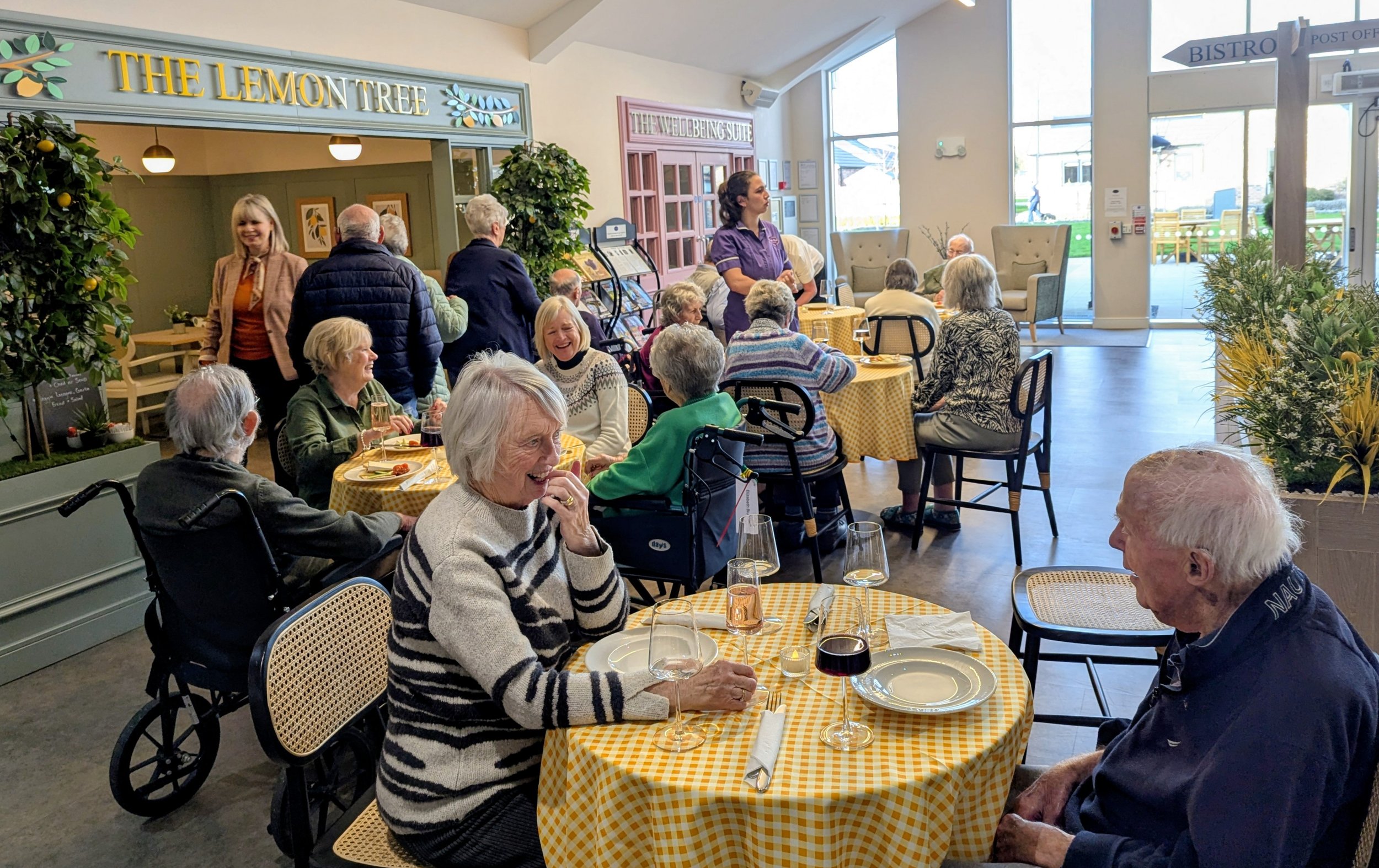
Lavender Fields, near Pocklington in East Yorkshire, is built around this model. The village offers independent bungalows through to full residential and dementia support, designed to evolve with residents without requiring a disruptive move as needs change. At the heart of the village sits The Hub, which includes The Stag pub, The Lemon Tree café and bistro, a Wellness Centre with a gym, hair salon, nail bar and therapy rooms, and a Multifunction Room for events and family gatherings.
The care home within the village, Provence House, is a 72-bedroom residential and dementia care facility. It is split into three distinct, self-contained wings, each supporting 24 individuals, with their own kitchenette, dining room and lounge spaces.
How do the costs compare?
Cost is one of the first questions families ask, and the honest answer is that neither option is cheap at the level of care most people need.
Live-in care typically costs between £1,200 and £1,800 per week for one-to-one support in the home. This fee covers the carer's time and is separate from any household running costs, food, utilities, and property maintenance, which the family continues to bear. If specialist nursing or dementia care is needed, costs rise further.
A premium care village sits at a comparable level for residential care, with the significant difference that the weekly fee covers accommodation, all meals, activities, and a full community of staff and facilities, with no household running costs continuing in the background.
For couples, the comparison shifts. Live-in care for a couple can be delivered by a single carer in many cases, making it proportionally more cost-effective than two separate care placements. A care village like Lavender Fields offers a different kind of solution for couples: the bungalow option allows a couple to live together independently on site, with the security of full residential care available in Provence House if either partner's needs increase. You can read more about how couples are supported at Lavender Fields.
The fees at Lavender Fields do not increase as a resident's care needs change. They adjust only for annual inflation and sector costs. For families planning over the long term, that certainty has real financial value. You can review what is included in the fee in full.
Make it stand out
Whatever it is, the way you tell your story online can make all the difference.
What about social life and wellbeing?
This is where the two options differ most meaningfully, and where individual personality matters enormously.
Live-in care preserves someone's home and their place in an existing community, neighbours, local shops, a familiar GP, perhaps a garden they have tended for years. For someone who is deeply rooted in a community and would find a move genuinely distressing, staying at home with good support is often the right choice, at least for a period.
The challenge is that live-in care does not automatically address loneliness or social isolation. Many older people, particularly those living with dementia or mobility difficulties, have already lost much of their social network before care becomes necessary. A live-in carer provides companionship, but one relationship is not the same as a community.
A care village addresses this directly. At Lavender Fields, social life is built into the fabric of the place. Residents can drop into The Lemon Tree for a coffee, have a drink in The Stag with family or friends, join an activities programme, or simply walk through the grounds and gardens with a familiar face from the care team. Life at the village is structured around daily rhythms that residents shape themselves, not routines imposed from above.
From Lavender Fields One of the things families tell us, after a loved one has been with us for a few months, is that they had not realised how isolated their relative had become at home. Sometimes a live-in carer does an extraordinary job and the person thrives. But we also see people arrive who have not had a proper conversation with a peer in months, not because they lacked care, but because care at home cannot replicate what it feels like to be part of a community. That shift, from being looked after to actually living, is something we see happen here regularly.
What happens when care needs increase?
This is the most important practical question, and it is the one where the two options diverge most sharply.
With live-in care, if someone's needs become more complex, the agency may need to provide a more specialist carer, two carers working in rotation, or overnight waking cover. Costs rise, sometimes significantly. If needs eventually exceed what can be delivered safely at home, a move into a care setting becomes necessary anyway, often at a point when the person is more vulnerable and less able to adjust.
With a care village, the range of care is contained within one community. At Lavender Fields, someone can move from a bungalow into Provence House as their needs change, and their social world, the faces they know, the spaces they use, the team they trust, remains largely the same. They do not start again somewhere new.
For people living with dementia in particular, this continuity is clinically significant. Disruption and unfamiliar environments are known to increase distress and accelerate decline. A model that keeps someone in the same community, surrounded by the same people, even as the level of care they receive increases, addresses this directly. You can read more about dementia care at Lavender Fields and how compassionate care works as needs advance.
Which option suits which kind of person?
There is no universal answer, but some patterns hold.
Live-in care tends to work better for people who are strongly attached to their home and community, who have good family support nearby, whose needs are likely to remain stable rather than increase rapidly, who have a property that comfortably accommodates a live-in carer, and who would find a move deeply distressing.
A care village tends to work better for people who value community and social connection, whose needs are likely to change over time, who are planning ahead and want a long-term home rather than a transitional arrangement, who would benefit from the reassurance of 24-hour professional support on site, and whose family wants to visit as guests rather than manage ongoing care logistics.
From Lavender Fields The families who visit us and eventually choose somewhere else are not wrong. Live-in care can be exactly the right answer for some people. What we do ask is that families compare the two with a clear picture of what each involves over time, not just in the first few months. The question is not just where someone will be comfortable now. It is where they will be living well in two years, or five. That longer view often changes the conclusion.
Is a care village a care home?
In the traditional sense, no. A care village like Lavender Fields is a functioning community that happens to include a care home within it, rather than a care home that has added some facilities. The aim is for care to feel like part of a thoughtfully designed lifestyle rather than a last resort. The Hub, the bungalows, the gardens, and the care team all serve that same purpose: to make later life feel like life, not a waiting room.
That distinction is worth holding onto when comparing options. Live-in care keeps someone in their existing home. A care village offers them a new home that is built for where they are now and where they are going.
Frequently asked questions
Is live-in care cheaper than a care village? At similar levels of care, costs are broadly comparable. Live-in care typically runs between £1,200 and £1,500 per week for one carer, excluding household running costs. A premium care village fee covers accommodation, meals, activities, and all care, so the comparison is not straightforward. For couples, the cost dynamics differ again and are worth looking at specifically.
Can live-in care manage dementia? Yes, to a point. A specialist dementia live-in carer can provide excellent support in the early and middle stages. In the later stages, when needs become more complex or unpredictable, the clinical support and specialist environment of a dedicated dementia care setting often becomes necessary.
What if my loved one does not want to leave their home? This is one of the most common and most difficult situations families face. It is always worth exploring whether live-in care could work as a starting point, while keeping longer-term options open. A short-term stay at Lavender Fields can sometimes help someone experience village life before making any permanent decision.
What makes a care village different from a care home? A care village offers a broader community environment, typically including independent or assisted living options alongside full residential care, shared social facilities, and an ethos built around quality of life rather than just meeting care needs. At Lavender Fields, that means a pub, café, wellness centre, gardens, and a full activities programme alongside Provence House.
How do I know which is right for my family? Visit both. Spend time in each environment. Think about not just the person's needs today, but what you want their life to look like in two or three years. At Lavender Fields, we welcome families who are still deciding and are happy to answer questions without any pressure. Get in touch or find out more about the care journey before you visit.
If you would like to see Lavender Fields for yourself, arrange a visit here and explore what village life looks like before you come.