

Can Couples Live Together in a Care Home?
The short answer is yes. Couples can, and do, continue to live together when one or both of them needs residential care. But many families do not know this is possible, and some care environments make it genuinely difficult.
This article explains what options exist, what challenges typically arise for couples, and how a care village like Lavender Fields approaches the question differently.
Why do couples often end up separated when care needs arise?
Most traditional care homes are set up to house one person per room and to provide one type of care throughout the building. When both partners need care, they can usually be accommodated together if their needs are similar. The problem arises when one person's needs are significantly different from the other's.
A common scenario: one partner has advancing dementia and needs specialist dementia care, while the other is physically frail but cognitively well. In a standard care home, these two people would be placed in separate units, sometimes even separate buildings. They may see each other daily, but they are not truly living together.
For couples who have been together for decades, this enforced separation is deeply distressing. Research consistently shows that maintained connection with a long-term partner has significant benefits for both physical and emotional wellbeing.
Can couples live together if they have different care needs?
This is where the model of care really matters. At Lavender Fields, the care village structure is designed precisely to address this.
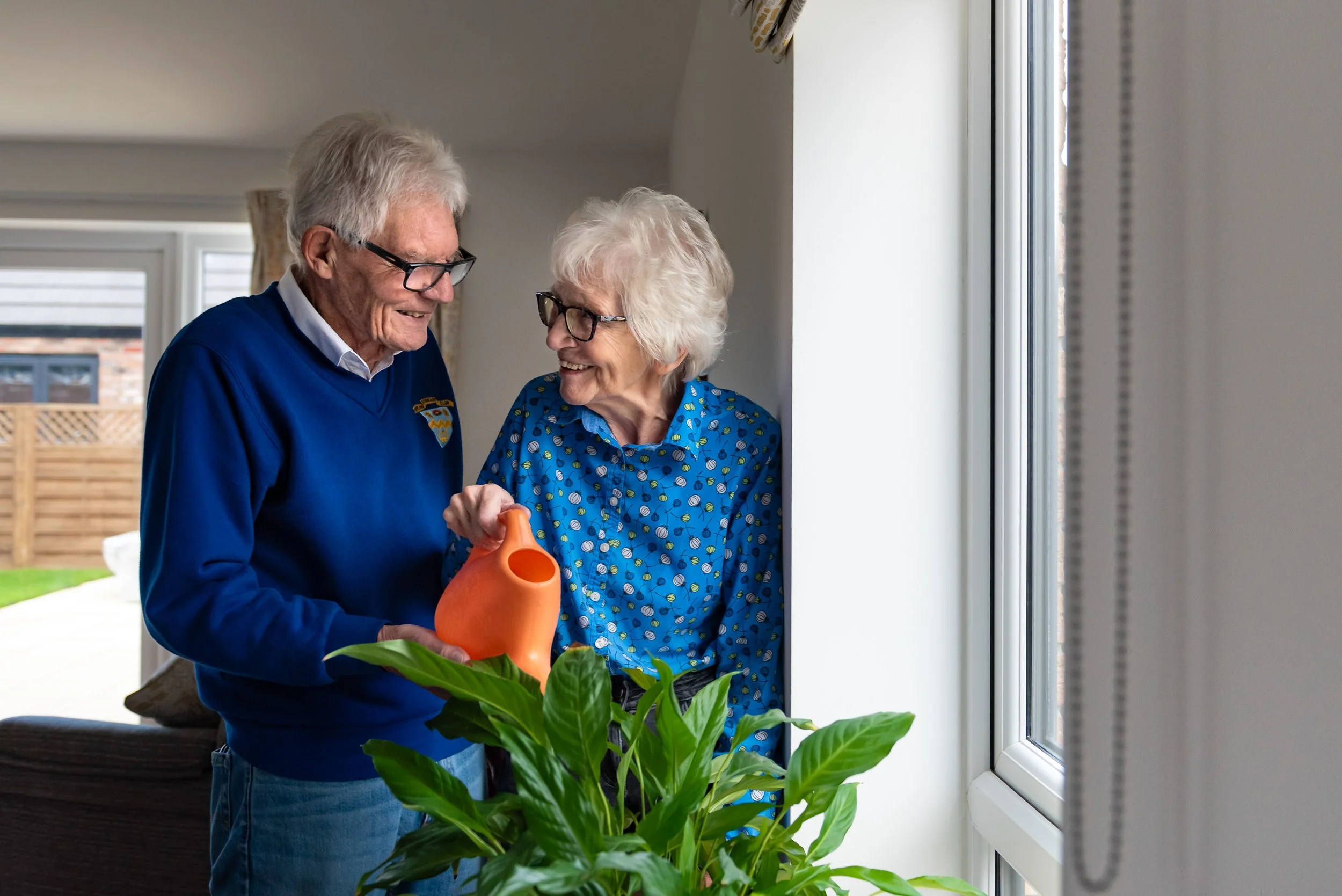
Couples who are still relatively independent, or where one partner needs only light support, can live together in one of the care bungalows on the village. Each bungalow has its own patio and garden, and residents have access to the full village, including the Hub with its pub, coffee shop, and village shop.
When one partner's needs increase to the point where Provence House is the right place for them, the other partner does not have to leave the village. They remain close by with easy, daily access, and their living situation is not disrupted by their partner's change in care level.
This is a meaningful difference from what most care homes can offer.
What if both partners need full-time residential care?
If both partners need the level of support that Provence House provides, they can be accommodated together within the home. Our team will discuss room arrangements, daily routines, and how to make the transition feel as natural as possible for both of them.
The priority is that the couple can continue to share meals, spend time together, and maintain the rhythms of their relationship. Care is planned around the individual needs of each person, without those needs pulling them apart.
You can read more about daily life at Lavender Fields and the kind of environment both partners would be moving into.
What if one partner has dementia?
This is one of the most frequently asked questions we hear from families, and one of the most emotionally complex situations a couple can face.
Living with dementia affects the whole relationship, not just the person who has the diagnosis. Partners who have been the primary carer at home often arrive exhausted, grieving, and unsure how to maintain closeness while letting professional carers take over.
At Lavender Fields, partners are genuinely part of the picture. Families are encouraged to be present, to share meals, to join activities and events, and to maintain connection in whatever form is most meaningful at that stage of the condition. Our dementia care approach is built around the whole person, which includes their relationships.
How does the care village model help couples specifically?
The village model at Lavender Fields creates something that a conventional care home cannot: a shared environment where couples can continue to have a social life together, even when their care needs are different.
Both bungalow residents and Provence House residents have access to the Hub, to the grounds and gardens, and to the activities programme. A couple where one partner lives in a bungalow and the other is in Provence House can still have lunch together in the coffee shop, take a walk through the gardens, or spend an evening in the pub. Their daily lives remain intertwined.
This is not something we have seen replicated in many care settings in Yorkshire or nationally. It is one of the reasons Lavender Fields describes itself as a care village rather than a care home.
What should couples ask when visiting a care home?
If you are visiting on behalf of a couple, or as a couple, these are the questions worth asking directly:
Can we be accommodated together, and what does that look like practically?
What happens if one of us needs a higher level of care in the future? Would we be separated?
Are there shared spaces where we can spend time together each day?
How do you support the partner who is less dependent while the other receives more intensive care?
How do you involve both partners in care planning and daily decisions?
At Lavender Fields, we welcome these questions. Our approach tothe care journey is built around keeping people connected to the people and things that matter most to them.
Frequently asked questions
Can a couple share a room in a care home? Yes, in many cases. Whether this is possible depends on the care home, room availability, and each person's individual care needs. At Lavender Fields, the team will discuss room arrangements as part of the initial conversation, and the goal is always to find a solution that works for both people.
What happens if one of us needs to move into a care home but the other does not? This is where the care village model at Lavender Fields offers something genuinely different. The partner who does not need residential care can remain in a village bungalow while still having daily access to their partner in Provence House. They share the same village, the same facilities, and the same community.
Can my partner visit freely if I am living in a care home? Yes. At Lavender Fields, visiting is unrestricted and partners, family, and friends are considered part of the community rather than guests to be managed. The Hub and shared spaces are open to residents and their families alike.
Is the cost different for couples? Each resident's care fees are based on their individual needs. The team will explain how fees work for both partners as part of any initial discussion. You can also review the pricing and what is included before visiting.
We are not sure whether we need care home support yet. Is it too early to visit? No. Many of the people who end up at Lavender Fields visit well before any urgent need arises. It is much easier to make a calm, considered decision when there is no crisis driving it. We are happy to show couples around the village, answer questions without pressure, and let you take your time.
Keeping a couple together is not always straightforward, but at Lavender Fields it is something we are genuinely set up to support. If you would like to talk through your situation or arrange a visit for both of you, get in touch with the team or explore more about village life at Lavender Fields.